Tuesday, May 6, 2014

CONSUMED WITH DISTURBING BEHAVIOR

(or, Some Fits of art that belong to Harmony Korine.)


This is a throwback piece originally published in the Jan. 2010 issue of the Central Wisconsin newspaper The Scene.


Sometime this year I pray to hold the privilege of catching a potentially life corrupting piece of no-rent cinema by the name of 'Trash Humpers' (view what passes just barely for a trailer here, www.harmony-korine.com). The 'plot details', such as they are, involve the day to day misbehaviors of a small mob of apparently geriatric assholes (embodied by a cast that includes Korine himself in grubby old timer masks and wigs) as they seek to raise the bar on all out anti-social deviance. The film sports a deliberately dodgy aesthetic, like some kind of oft viewed VHS bootleg derived from a clandestine tape trading circle. This intriguing mess was wrestled together in a reported few weeks time for change by an erstwhile enemy of the mainstream named Harmony Korine.



Korine is a singular artistic voice out of Nashville, Tennessee that first left scars on the public conscious as the father of the script that became Larry Clark's unwavering debut 'Kids', a movie that addressed many of the darker truths of juvenile delinquency. That picture's critical and art crowd notoriety earned Korine the freedom to adhere to an unfiltered exploration of some of his own thematic whims and obsessions via a series of films, publications and exhibitions that would nurture a fervent cult status.

Among the films, the first (and, by far, finest) would be a one of a kind number, built to polarize called 'Gummo'. The first time I laid eyes on this glorious little eyesore, I was boozing it up proper at a house party that resisted in the hateful majority when I popped the tape in (circa 1998) convinced we would all be changed for the better. I found myself imprisoned in its' gut level fairytale ramblings and way left field visionary tendencies to the point where I became completely fixated, I couldn't tare my sockets away from the screen.

Korine's pseudo apocalyptic chronicle of a bleak living atmosphere in small town Ohio (post tornado) is like a trip through the most criminally endearing and car crash compelling hell the mind can fabricate. One lasting image follows another for one and a half hours and then it's gone, leaving one with the sizable task of processing just what has transpired. The very loose sketch of a storyline involves two bottom feeder protagonists (Nick Sutton, Jacob Reynolds) and their interfacing with peers and perpetrators in about the streets of what can best be discerned as an 'impoverished' neighborhood. To a manic soundtrack of droning narration, death metal and sludgy ambiance one can bare helpless witness to the loopy sights of redneck royalty drinking, fighting, sporting mullets, drowning cats, being gross, open heart confessing to a homosexually inclined midget and defying political correctness at every open opportunity.


Two specific moments that encapsulate the bent worth of the picture for me are; 1-a junkyard showdown of sorts between two grubby pre-pube cowpokes and a poor fella sporting large fake rabbit ears that they proceed to attack, rob and berate at beautiful length. 2-a portly retarded chick dressed in a Krokus t-shirt holding a plastic baby doll and reciting her 'A,B,C's'. That's not to mention the  shirtless wrestling match involving a fold out table or the guy who pimps his obese, half-wit sister or the kid eating spaghetti while bathing in filthy water or.....get the picture yet?

As can be easily gleaned from the above rambling, this is a particular work for a particular mind set. If you ever find that you are growing impatient with the big budget, formulaic narrative standards long established as commercially viable, if you have trouble forcing yourself into caring for Sandra Bullock and her forced good Samaritan routine with some poor homeless football prodigy or John Cusack outliving the end of the world, then I think Mr. Korine has the antidote for your wayward soul.

With 'Trash Humpers' still lingering on my 'as yet to see' wish list, I will have to lend passing nods to the rest of Harmony Korine's directorial efforts.

'Julien Donkey-Boy' came close on the heels of the almighty 'Gummo' and suffered immediate letdown syndrome brought on by over zealous expectations on my part. It just goes to prove, one can only be taken aback the way Korine's crazed debut did me once, all coming after begins to feel redundant. So with 'Julien' there was an initial impression of 'seen this sorta thing before', as the film indulged in many similar themes and ideas though with a nod more to the linear in terms of the narrative pattern.


Repeat visits to this sophomore effort after I managed to vacate any pretentious expectations allowed me to extract the jewels of eccentricity that help 'Julien Donkey-Boy' triumph on its own malformed terms. This saga of the manic titular individual (played by 'Trainspotting' alum, Ewen Bremner) his quasi-militant pops (the great German director Werner Herzog, who dives in full force) and the sister (ChloĆ«  Sevigny) with whom he is expecting an offspring actually rests upon a basic domestic drama outline, adhering to more linear terms in juxtaposition with 'Gummo'. But, if you think Harmony Korine is about to safely coast through this thing on formula alone, let me tell ya folks, not going to happen.

Korine and his cameraman, Anthony Dod Mantle, have conspired to rep the obvious mental shortcomings of dear Julien care a multi layering of the initial footage. They've taken it from digital and dumped it onto 16mm film stock and blown the result up to 35 mm to really grain drench the imagery into a remarkably erratic level. Never, to me, has such manic delirium held this type of dreamy appeal. The employment of heavily distorted visuals and even the occasional sharp switch to still photography and random blurring effects at first may come off as pure stunts of artsy self gratification, but, upon further digestion, read more as the spill over of the warped energy emanating from the eccentricities contained herein.


Korine even manages a fair collection of stand alone moments (though markedly less so then in 'Gummo'). Prime among there are the sight of a group of blind people getting down at a bowling ally and Julien's heavily put-upon brother (Evan Neumann) wrestling viciously with a plastic garbage receptacle (this director sure digs his humans battling inanimate objects). Oh, I cannot disregard the diminutive Black Albino ('straight from Alabama, way down south and you know that I'm a...') busting loose on the freestyle.

The film was created under the guidelines of the Dogma 95 manifesto (which can be retrieved here-http://en.wikipedia.org/wiki/Dogme_95#Goals_and_rules) set forth by Danish mavens Lars von Trier and Thomas Vinterberg, though Korine managed to take liberties when it suited him. The finished film ended up in the loving arms of cult cinema nerds after some scattered play-dates (mostly fests) and Korine stepped away from features for several years to focus on various other outlets (shorts, music videos, a script for another Larry Clark film-'Ken Park', photo exhibitions and a dabbling in substance abuse and depression) before landing his biggest scale project in 'Mister Lonely'.

The problem with this tale of love, angst and endless daydreaming shared by a commune of celebrity impersonators is that its higher end production values and semi-name actors work at some opposition to the Harmony Korine methodology in favor of the stranger things in this here human race. There is a measured stifling quality on hand as we follow a faux Michael Jackson (Diego Luna) and Marilyn Monroe (Samantha Morton) and various others as they struggle to mount an ambitious performance piece for the locals in a remote section of Scotland (!!). Yes, absurd, but played far too straight too much of the time to truly work. Only an altogether out of place side plot involving Werner Herzog (again, a scene stealer) as a priest flying relief missions in Central America with a handful of fearless, sky diving nuns provides any true link with the inventive retardation of either of the director's previous films.

Korine himself has suggested some dissatisfaction with both the greater demands of a more expensive (for him-$8-9million) project and the finished result. Thus we come full circle to the film he has created partly as an antidote to said misgivings and partly as an extension of the freak voice that made his freshman and sophomore pictures so worthy. 'Trash Humpers' could very well be the apex of Harmony Korine's love affair with the romantic abnormalities of human behavior and the ever crooked paths they nurture into the kind of storytelling he finds priority level film making material.
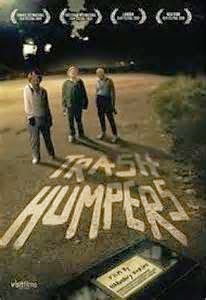


I hope I will not be the only fool waiting in anticipation for a shot to spend some screen time on some random Nashville street with a few filthy degenerates giving blatant irrationality a good/bad name.

One more thing, it should be noted in passing that both 'Gummo' and 'Julien Donkey-Boy' are available on the cheap ($5.79 each) at the friendly Internet warehouse Amazon.com.


Anything crude and/or impolite that anyone would wish to add can be submitted here-killpeoplenamedrichard@yahoo.com

Sunday, April 20, 2014

ROWDY LIL' DEVILS


(Print version published in the May 2014 issue of The Scene Newspaper, scenenewspaper.com)

It has come to my immediate attention that some of the more necessary recent examples of quality genre cinema appear to center the weight of their chosen plotlines around some curiously small packages. The most obvious of the commercial, mainstream representations of this can be found in the work of director James Wan, most specifically 'Insidious', but I was thinking more in terms of reduced popularity yet equal (or greater) value and I have two wholly fitting flicks that fit this criteria; 'Here Comes the Devil' and 'Knights of Badassdom'. It is with these two very differing slices of economic yet effective little big threat storytelling that this month's chapter in slightly off the radar motion picture analysis and incessant rambling is prepared to devote itself.


Here Comes the Devil.

When the comfort zone of a typical familial structure becomes uprooted, say by virtue of the mostly commonplace interferences of emotional, financial and/or fidelity issues, the chief members are left with the taxing yet inevitably surmountable task of picking up the metaphoric pieces of their given lives and continuing to soldier on. In the moody and unapologetically graphic case study of the young Mexican family unit in 'Here Comes the Devil', however, we find the main parental pairing abruptly forced to contend with the sharp and dedicated intervention of a cruelly possessive element that seeks to drain away the innocence of their two prepubescents in favor of a more malicious alternative.

The set up is simple, following a startling prologue of sorts involving a juicy lesbian tryst interrupted by a maniacal house invasion and subsequent bloodletting, the base action shifts over to a sunny Baja California vacation site being occupied by the film's protagonist foursome. While Sol (Laura Caro) and Felix (Francisco Barreiro) sun themselves with nary a care to mention, their kids, Adolfo (Alan Martinez) and Sara (Michele Garcia) are nearby dealing with the alien prospect of Sara's inaugural encounter with that strange feminine occurrence known as menstruation. A quick trip to a local convenience store to deal with the inconvenient 'girl' problem and we're back in business with the kids looking to explore some area caves and the adults just looking to further pursue their relaxation agenda, only on a more romantic level (naughty, naughty).  A couple of beats later finds them snoozing in their car, the sun has set and their children have not reported back.


Thus begins the thrust of the whole 'parent's worst nightmare' come to life (and then some) scenario that really informs this delectably demented piece of modern horror. With the local law alongside, the couple frets and scours the surroundings to no avail, only to have their babies appropriated off some remote road the very next day and delivered to their door. All is set to right, or so we are briefly mislead to believe.  The kids almost instantly begin to exhibit a notably detached, vacant quality and suspicions arise that they may have been more than just lost in the cavernous hills. At first, after some snooping in and around the area of the disappearance, a local social reject may prove to be a prime suspect and solution to the mounting mystery of what hath molded the children in such a dark and uninviting fashion. In fact, the spectre of some variant of child abduction/unspeakable contact eats at the parents to such a degree that they carry out their rabid phobia to ultraviolent ends (no direct spoilers, just know the effects crew more than earned their keep). This all leads the parents on a downward spiral of their own en route to the true source of the madness, the dread that awaits with a proper solution they could probably due without ever encountering.


'Here Comes the Devil' marks the 10th feature offering of a deft Spanish fella named Adrian Garcia Bogliano (with another feature, 'Late Phases' waiting in the wings). He infuses his weird and wonderfully creepy opus with healthy measures of the requisite horror staples of sex, gore, lingering unease and lurid personas taking the task of boundary pushing and amping the shock  and awe factor to acceptably elevated degrees. He has also made it clear in previous media coverage his love and adoration of the exploitation cinema of the 1970s and 80s and that is in blatant display care the warm, somewhat sleazy imagery and fearless employment of sharp zooming in on key moments (Bogliano has also stated his specific use of lenses based on those used in comparative old school favorites). This all combines to make for one of the more satisfying and fully unnerving horror entries in recent memory. Produced for a relative pittance by even so-called low budget standards, 'Here Comes the Devil' shines with a polished look and fitfully creepy vibe that is certain to endear it to a wealth of genre devotees.

The rich looking Blu Ray from a company called Magnet Releasing comes complete with the usual audio commentary input form the Bogliano man himself plus several bits of behind the scenes info to help flesh out the origin of this warped lil' devil. Recommended to all who still hold hope for the future of all things horrific.


For more info, check-magnetreleasing.com/herecomesthedevil

Knights of Badassdom.


Back in the summer of 2011 I was attending the enormous nerd-chic mecca known the world over as San Diego Comic Con when I found myself surrounded by a grand party of fools dolled up as some sort of medieval war party (or cast offs from a Manowar video shoot, take thy pick) and fully reveling in slapping the piss out of one another with big, realistic looking weaponry right outside of the convention's most beloved of locales, the infamous Hall H. Turns out, this was all a part of the publicity juggernaut for a charming little love letter to something dubbed 'Larping' (where participants enact a roleplaying scenario on a three dimensional scale) named 'Knights of Badassdom' that I would have to wait a further 2 1/2 years to actually witness.  The film, for one reason or another, sat dormant until being swept up by distributor eOne Entertainment for fleeting screenings and a decent home video berth.


The story involves a basic collection of boy buddies, the majority of which cling to this Larping thing as if it were a serious religion. When one of their roommates, Joe (Ryan Kwanten of 'True Blood' fame), finds himself abandoned by his true blue love of all that is worth living for the resident nerd posse takes it upon themselves to lure him into a weekend role playing getaway. The gents, made up of a fairly solid batch that includes Steve Zahn (a very accomplished thespian who saw this picture released in the near vicinity of more recognized fair that he also took part in like 'Dallas Buyers Club', now there's a strange double bill) and that mightiest of little big men, Peter ('Game of Thrones') Dinklage, see this as both a bonding ritual to help bring their bummed bro back up to par and as a method of further strengthening their dominance in this fabricated geek realm.


Complications and such arise when Zahn's character, Eric, invokes a diabolical succubus that so happens to occupy the body of Joe's former flame. Once this disturbing revelation comes to the fore, our noble lads must find a way to wrangle their fellows in geekdom to help combat the rising body count and become true, victorious...er bad asses. The guiding hand behind these ramshackle events is Joe Lynch, a director whose most noted previous credit is 'Wrong Turn 2' coupled with acting/producing chores on the late FEARnet series 'Holliston' (which also featured the equally 'late' Gwar frontman Oderus Urungus). Lynch has crafted a right serviceable mash-up of comedic shtick and blood splattering spectacle in spite of the much mumbled about budgetary short comings and debated handling of the actual final edit of the film. The pace and progression of the whole affair is adequate and the technical aspect (especially the mostly old school, hands on make up and gore effects) only aids in the cause. By the time the film rambles its imperfect way to the climactic stage and the final monster is let loose on the party, the picture will likely have endeared itself to many a game viewer (awful pun, you're welcome). The cast gives it like seasoned pros, both the above mentioned peeps as well as Summer Glau (the gal from the T.V. shows 'Firefly' and 'Terminator: The Sarah Conner Chronicles') filling out the hot babe/rebound love interest part and many, many actual dedicated Larper types (many of which were among the crowd lurking around San Diego Comic Con way back when) all do their duty at a commendable level.  


The video release of 'Knights of Badassdom' contains several interview segments with the cast members and the director along with a lengthy panel presentation from the greatly aforementioned Comic Con Hall H appearance wherein many of the players discuss the project and their approach to the material and also entertain questions from selected lucky nerds from the massive crowd. This whole thing makes me ever so eager to return to another ridiculous convention down in southern California this July. Can't wait.

Again, info.....here-knightsofbadassdom-movie.com

Tuesday, March 18, 2014

BEAST IT LIKE YOU MEAN IT.

THESE MONSTERS CAME TO PLAY.


It would appear as though we have yet another Godzilla flick looming on the horizon. Yes, it is another Americanized attempt to recapture the energy and brand-name charm that fueled the original, perennial Japanese juggernaut that has thus far spawned at least two very underwhelming state side knock offs ( New World Pictures' hefty overhaul of 'The Return of Godzilla', rechristened 'Godzilla 1985' and the weak kneed 1998 eponymous effort by uber schlockmiester Roland Emmerich that seemed to find some odd, blockbuster leading man cred in Matthew Broderick). With still another group of ambitious souls so willing to take the burden upon themselves to make a serious bid at a high scale and truly worthy resurrection of the big screen presence of that most universally renowned of lumbering, heavily destructive creatures, I feel a tad motivated to take a glance back at the old school days of goofy, Japanese spectacles devoted to the art of big rubber abominations  causing a mad variety of disorder and, most paramount, knocking into and toppling a multitude of miniature model cities and the like.  

I fondly recall having my share of affectionate reactions to many of the 'Zilla epics I caught at random on cable television in my youth, not to mention that Saturday morning variant that unspooled in the late 70s (anyone remember the ridiculous 'Godzooky'?) and continue to be drawn to the more modern projects that seek to keep the 'big monster' or, 'Kaiju' as them Japanese folks call it, genre alive and well like big Guillermo del Toro's vivid monsters vs. robots opus 'Pacific Rim' (that one Beastie Boys video, 'Intergalactic' had it going on too).


So, in keeping close with this theme of big bastards wrecking stuff, it seems all too fitting to lend some quality column space to a perfect tie-in of sorts to this impending Godzilla entry as well as all the wonderful rubber monster fun stuffs so many of us have come to adore. 'Ultra Q' is an often goofy and quite charming little monochrome T.V. oddity born in Japan in January of 1966 as both a cash in on the booming Godzilla/Gamera (the flying turtle) craze of the era as well as the popularity of American anthology programs like 'The Twilight Zone' and 'Outer Limits'. The basic, on running premise is established almost straight away as an overly ambitious newspaper reporter/staff photographer and two foolhardy pilots (embodied by Hiroko Sakurai, Kenji Sahara and Yasuhiko Saijou respectively) rush to investigate a strange occurrence at an underground mine which leads to the discovery of a menacing lizard (a resourcefully reconfigured costume used in a previous Godzilla production) that our protagonists must find a way to thwart for the betterment of mankind. In succeeding entries in this series, the trio, with some help from time to time from a Professor Ichinotani (Ureo Egawa) find themselves at odds with all manner of startling oddities that threaten to upturn the fabric of their surrounding normalcy.


Thus the viewer is graced with a veritable menagerie of living, raging abstractions, creatures and fabrications equal parts menacing and completely absurd. Beings culled forth to fulfill the 'Ultra Q' roll call for mysterious villainy include (yet are hardly limited to) an aggro beasty born of volcanic rock, a big, dopy looking ape man, a freaky acorn-like monster that bounces around (a personal fave and the cover boy for this series' DVD reissue set), a massive snail with laser beam eyes and a big, bloated, loopy looking walrus that lurks in cloud formations. Each passing episode proves packed with great camp surprises and enough clever plotting to suffice the slight 25 minutes allotted to each of the 28 total separate scenarios.

'Ultra Q' was created by a man named Eiji Tsuburaya, who served as a veteran visual effects director at several Japanese production companies, the most famous of which, Toho Studios, assigned him to labor on many of the great 'Kaiju' productions including those incorporating both King Kong and Godzilla. Tsuburaya's initial desire for 'Ultra Q' ( initially entitled 'Unbalance') was for it to go in a more brooding and mysterious direction much in the Twilight Zone vein of things until the show's backer, The Tokyo Broadcasting System, pushed for the inclusion of all the curious monsters. 'Ultra Q' was to be the first in a long line of 'Ultra' series that continues to this very day although the most overly popular, 'Ultraman', was the first to be exported to other territories. No matter, the fine people at Shout! Factory have made the concerted effort to corral the whole of this 'Ultra Q' puppy into one fine and handy, 5 disc DVD package so we simple American fools can soak it up ourselves. The show looks as good as it can for being some 50 odd years old and many of its romping creations may just prove unavoidably addictive to the true cult cinema fanatic. One of the most expensive television undertakings in its native land in its time, 'Ultra Q' may have aged in the direction of visually quaint but that does not discredit its place in the history of fantastic storytelling. Recommended to those who dig their monsters with a solid dose of infectious tackiness. More info here-http://www.shoutfactory.com/product/ultra-q-complete-series


THE LAST 5 FILMS I'VE SEEN (as of 3/19/2014)


1. Birth of the Living Dead. (First Run Features)- Again with the little movie that started all of this 'Warm Bodies', Zombie Walk, 'Walking Dead' hyperbole. George A. Romero and several of his legendary, debut feature's stout admirers (including producer Gale Anne Hurd and indie madman Larry Fessenden, who helped pull this documentary together) wax historic and delve into yet another intricate analysis of 'Night of the Living Dead', its' genesis and subsequent, lasting impact (positive and otherwise) on the horror community and pop culture in general. Plenty of note is made of the prevalent political and social upheaval at the time of this film's conception (the late 60s) and how said factors may/may not have injected influence into the project. The most compelling factor contained within this documentary, for me at least, are the nuts and bolts details of the piecing together of a grassroots, independent (before being 'Independent' was cool) feature film against all the expected odds and shortcomings that these sort of things almost naturally come into contact with. Not at all a landmark accomplishment but 'Birth of the Living Dead' should appease most film nerds and N.O.T.L.D. completests


2. Wicked Blood. (eOne Entertainment)- Serviceable criminal antics and melodramatics set in Baton Rouge for maximum Southern seasoning. A bright young lass (that little mrs. sunshine herself, Abigail Breslin) sets to the task of double dealing her way out of a suffocating familial drug dealing operation lorded over with a firm certainty by her stone serious uncle (Sean Bean). The plot proper involves many of the usual devices and beats suited to this sort of pot boiling endeavor. There's a rival drug dealer (James Purefoy) holding a significant secret, a knuckleheaded henchman (Jake-pale imitation of Gary-Busey), the dedicated dope cooker (Lew Temple, often shown getting high on his own supply) and the requisite number of shots of people pointing guns at one another. Nothing much here to dub as astonishing, but it might just do the time killing, rainy day movie rental trick.


3. Unidentified. (Dark Sky Films)- A gaggle of solid 'bros' do the getaway trek to sin city deluxe, Las Vegas. Along the way, the far and away most out of place of the bunch, a goon with a YouTube fixation (Eric Artell) convinces the group to detour into an abandoned testing site where some predictably unnerving events unfold leading to a slowly manifesting, other worldly stain on the remainder of their vacation. Once in Vegas the lads set forth to drink, rabble and (near fatally) gamble their way into oblivion. This flick works to a fair degree in spite of its adhering to the oh-so played out modern day convention of the 'found footage' technique (the above mentioned nerd character never goes anywhere with out his digital camera, never mind the real life fact that most casinos, strip clubs and such frown intensely on such trinkets). There are a handful of stand out scenes and gags that carried the whole above its many less inspired moments (the underground poker gig, run by a shady figure with, let's say, an odd personality quirk comes as a sort of welcome shock) and its closing stretch is surprisingly engaging as the film ditches most of the goofy ingredients for a legitimate measure of suspense. Directed by Jason R. Miller, who put in time on several projects by Adam Green, the 'Hatchet' guy, if that's any help.


4. Old Boy. (Film District)- Yo Spike!  What gives with this nice looking yet fully needless reworking of the much cherished Park chan-Wook adapt of the equally celebrated manga by Garon Tsuchiya and Nobuaki Minegishi? I mean, I guess it comes as an intriguing surprise initially that the director of potent cinema like 'Do the Right Thing', 'Clockers' and the ever mighty 'Malcolm X' would think to tackle such a tricky piece of pulpy storytelling. The end result, however, is only somewhat above the level of a scaled down, slapped together imitation.


Yes, I hear the producers pushed poor Spike Lee into forsaking his reportedly more intricate and in depth, 140 minute initial cut for the more compact, nearly 40 minute lighter version now commonly available. Then why did they so glibly toss the film to theaters with minimal promotion so it would die an easy death?  Seems like this take on an imprisoned man abruptly released to solve the mystery of his incarceration was never deemed too worthy of anyone's adulation. Better luck on the next one (the Kickstarter funded 'Da Sweet Blood of Jesus'), 'cus I still think you got game. Oh and Sam Jackson's in it, his first film with Spike since 'Jungle Fever', so expect some serious profanity.


5. The Last Days on Mars. (Magnet Releasing)- Stop me please, if you've heard this one before; a group of scientists and other assorted space travelers at work on the surface of the so-called 'red planet' are about to wind down their stint and punch their ticket back to Mother Earth. One member of the exploratory posse makes a convenient, last minute discovery on a slide at his lab station that may be suggestive of something resembling life out there under the Martian landscape. Further investigating slowly but surly leads to, guess what?, bad news and genre servicing bursts of suspense and terror mostly incorporating lots of bickering souls attempting to outlast peers who have come under the fatal spell of some form of viral force that reduces decent human folk into blood thirsty, raging zombie types. Yup, that's about all folks. Joins an inexplicably growing body of admittedly competent and fairly well cast films (see 'Europa Report' for further recent example) that basically work to drag the 'Alien' formula down to a smaller scale, lower budgeted and faintly artsy level. Not awful but not awfully necessary either.


Any feedback? Hit me up, killpeoplenamedrichard@yahoo.com

Friday, January 24, 2014

Kill Them All But One.


 (an article originally published in the May 2012 issue of The Scene)


When the world as you know it is on the brink of irreparable collapse and the majority vote of the younger generation seems to be leaning overwhelmingly toward a permanent, 'fuck you!' state of mind, what would be the most productive way in which to attempt to address the situation?

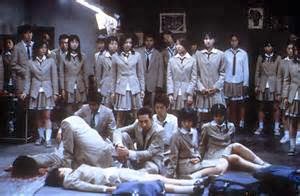
Simple enough, take a fat batch of these rowdy, disrespectful brats, toss them on some remote locale and have them fight 'til death until only one lucky soul remains. For extra good measure, have their former teacher (who's class they often avoided) supervise the whole bloody event and share the cruel outcome with a sensation starved general public. Such is the basic, catchy premise for the now notorious (in cult film sub-circles) Japanese grown slice of dystopian flavored savagery, Battle Royale. The film does propose a 'what if' outline of such an alternate reality where, devoid of a confident infrastructure and a stable, civil population, the powers that hope to restore any portion of order have reduced themselves to employing the youth as dependable fodder in a succession of morally bankrupt war games meant to help satiate the nagging demands of an overpopulated citizenry starving for more than just eats. The picture never gets overly explicit on the detailing of the how, when and why aspect of this society's apparent dire straits, but it's enough to know that times are tough all over and the kids must suffer their fair share of the unholy consequences.


Thus the invention and implementation of the Millennium Educational Reform or 'Battle Royale' Act. Selecting random classes by way of national lottery, the governing body (such as it dictatorially is) is freely able to ease on to a thinning of the herd (a more blunt and unapologetically fascistic variant on our real life practice of patriotically manipulating poor, gung ho kids to allow themselves to be groomed for the kill and to be shipped off to fight often meaningless combat). Once transposed to a deserted, nondescript island, the chosen ones are each read the rules and regulations of this so-called game that proves to be their sorry lot. Each player is issued a supply bag plus a random object that they must somehow use as a weapon (everything from highly useful firearms and sharp objects fit for stabbing to something as completely worthless as a stove pot lid, some get lucky and others get the short straw) and are ushered on to kick off the three day long, kill all or be killed off competition.


Attempts to resist the game or flee the island to the safety of the real world (or what now passes for it) are abruptly discouraged by way of handy explosive devices fitted inside snug neck brace like contraptions applied to each of the contestants. They try anything funny, the brace goes POP! and their throat will open up in due fashion, fanning the immediate area with a vivid, crimson shower. With the intense particulars of the game firmly established, the ensuing melodrama sees old wounds reopened, friendships compromised, flimsy grade school social systems collide and combust and genuine, youthful affections clear the path for handy suicide pacts.

Commanding over this troubling, ultra violent molestation of the normally harmless by comparison tropes of the rebellious teenager genre is a long shopworn soldier of the Japanese cinema, Kinji Fukasaku. Making his 60th directorial entry with Battle Royale, Fukasaku reaches an apex in a career he has been banging away at since 1961. He has affixed his mark on such titles as Battles Without Honor and Humanity, The Black Lizard, The Green Slime, Message From Space, Virus and many, many more than I feel like reiterating here. Fukasaku was also responsible for helming the Japanese segments (along with Toshio Masuda) of the all star, Hollywood WWII opus Tora ! Tora! Tora! (when that one hack, Akira Kurosawa got himself fired) so you just know the guy has his chops refined and honed up for tackling damn near anything, especially something as safe a bet as a youth gone wild scenario.


Turns out, a main portion of the motivation for Kinji Fukasaku to take on the production of Battle Royale (adapted by his son, Kenta, from the popular, same named novel by Koushun Takami) stemmed from his wartime imprintings as a teenager slaving away as a munitions worker and developing a deep set disdain for all manner of adult, authority figures (most importantly, those who represent the government of Japan). The curious thing about this is that it seems to have inspired the director to impart a significant measure of empathy toward his relatively naive protagonists, allowing the plight of these poor pubescents pushed into class execution to have a greater impact while the elder figures mostly lingering in supporting statuses remain deliberately underdeveloped. The sole adult who does manage to eke out some shading of nuance over the course of Battle Royale's two hour litany of relentless carnage is the former school teacher Kitano (essayed here by Japan's beloved jack of multi trades Takashi 'Beat' Kitano, a man who earned his way to fame as a comedian/television personality and additionally as an actor/director with such films as Violent Cop, Brother & Outrage) a man off put from any facet of happiness as a result of a dismal family situation (explored in greater depth in the much inferior sequel, Requiem) Takashi does his darnedest to make this sap sympathy worthy.


As the picture ambles its way toward what one would assume to be an inevitable denouement, it appears to take prioritized pleasure in dissecting and, at times, even deliberately satirizing the particulars of the often clique driven structure of this teen aged caste system that has been set on its head. Battle Royale's total dedication to brutal mayhem as a method of enhancing the impact of its rapid fire brand of socio-political mockery has led to its grandstanding amongst the hallowed annuls of cult filmdom. The fairly odd twist to all of this is, until this very year we live in now, Battle Royale has never once been granted an official, licensed home video berth in these United States. Now, theories and suppositions on this matter very, everything from a lack of distributor interest or financial confidence in this 'product', to the hot potato suggestion (by some) that this America was not ready to digest a film as heady as this, especially during its initial bow, right in the thick of the kids of Columbine and their nihilistic antics back at the close of the 20th Century. 

Nothing to fret much over though, as time (and pop culture convenience) seems to soothe most troubles. As fate would have it, the generous folks at Anchor Bay Entertainment (anchorbayent.com) have taken it upon themselves to wrangle together something called Battle Royale-The Complete Collection , a title that proves to be a slight misnomer (as anyone who already owns one or more of the easily obtained import DVDs of either film can attest). This is, none the less, a noble and very polished attempt to bring this saga to the Red, White and Blue once and for all (coincidentally corresponding with that one big scale, Lion's Gate film adaptation of the mega chic, book series about young-ins in a depressing future world forced to pick one another off and such to the sound of box office cash registers endlessly ringing).


The fresh, four disc set (available as both DVD and Blu-Ray) presents both Battle Royale films (the first in both theatrical and slightly extended director's cut versions) and a decent (yet far from complete) selection of bonus materials (though with nothing at all to represent the sequel), which lend insight into the behind the scenes mechanics and promotional thunder that encompasses the B.R. phenomenon. Shamefully, there are no commentary tracks of any kind nor deleted scenes to satisfy that trivial desire for something beyond the films as they stand completed. Some passing, minor complaints to be sure, but it hardly diminishes the fact that Battle Royale has finally been granted admittance into the mainstream, albeit probably to bask in the residual effects of a dumbed down, PG-13 blockbuster with a hot, blond trophy lead that serves, at best, as a flavor of the moment.


No matter, track it down and placate your hunger for crazy, quality Japanese ultra violence. You won't be underfed.


Also, something totally unrelated.

Everyday Sunshine: The Story of Fishbone.


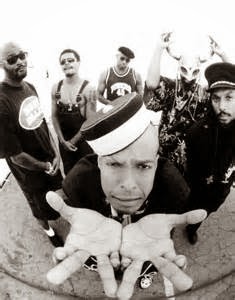
One of the most tragically undervalued (in commercial terms mostly) and yet thoroughly influential bands of the past several decades finally, almost, receives its just due with this not at all landmark but still very welcome and entertaining documentary profile. Piecing together the origin through modern area timeline of this South Central L.A. born outfit by way of standard practice devices like, industry peer commentary (including but not limited to; Ice-T, Les Claypool, Gwen Stefani, Mike Watt and that overrated bass whore from the Red Hot Chili Peppers), plentiful archival footage and a guiding narrative voice lent by Mr. Laurence Fishburne, filmmakers Chris Metzler and Lev Anderson shed light on the means and methods by which such a wildly varied and potentially implosive collection of creative voices managed to change the formula of what a 'rock' band is perceived to be.

Not surprisingly, the film gains its sharpest nuggets of insight from the two primary, original founding members; Angelo Moore and Norwood Fisher (the only two cats who never abandoned the Fishbone rollercoaster at any one point). The pair explicate on the epic lifespan of this band that never climbed higher up the ladder of fame than their Lollapalloza/'Reality of My Surroundings' peak. From a socially awkward first meet up in high school all the way to bickering like an old married couple while enduring the cold truths of greatly reduced concert attendance and record sales (be honest, how many of you out there who even knew who this band was even thought they were still around?), these two remain the key voice and recount without hesitation everything from getting major label love while still in their teens, cutting some stellar records ('Truth and Soul', 'The Reality of my Surroundings', 'Give a Monkey a Brain...and He'll Swear He's the Center of the Universe'), partying it up too much, seeing members cycle in and out and back again and even suffering the loss of the pivotal guitarist Kendall Jones to a religious sect or something (an ensuing intervention attempt nearly led to Fisher's incarceration).


Truly one band that shone brighter on stage (their live energy is astounding) then they ever could in a confining record studio, Fishbone still succeeds in the crafting of worthy enough releases to this very day. Anyone who has bought into the sonic benefits of No Doubt, Primus, Mordred (yeah, right) and those Chili Pecker boneheads have Fishbone, in no small part, to thank for that. So do your damn self a solid and look in to their discography, catch a live gig if at all possible and set aside a few hours for Everyday Sunshine: The Story of Fishbone (the DVD of which is stuffed with quality bonus goodies and can be procured here-fishbonedocumentay.com). Now let the majesty of the 'Bone' be overlooked no further.

Monday, January 20, 2014

Hell is Where the Heart Is.

Being the efforts of a local film dude inspired by Pig Destroyer.


Stowed deep away atop the mighty House of Heroes comic book hot spot in the thick of Oshkosh is a grand laboratory adorned with majestic posters (mostly of the original 'Evil Dead') and copious objects truly fitting a film savvy scholar that houses one mad soul hard at labor on a challenging collection of projects and ideas meant to work the value of the area filmmaking community to an ever higher level. The soul in question is that lovable man on a seemingly endless movie mission, John Pata. Pata, many of you should swiftly recall, is one of the chief creative engines behind one of the most positively received and widespread cinematic success stories to ever have been generated out of the Oshvegas/Fox Valley landscape, 'Dead Weight'. That film (which finally landed a fully legit, national distribution deal via Kino Lorber and became available online and on store shelves late last month) signaled the clear arrival of a potent cinematic commando with a natural knack for the form.

For those yet to witness 'Dead Weight' (a number of the populace that hopefully continues to dwindle), it is the tense, often troubling story of a young man named Charlie (Joe Belknap) and his increasingly self centered quest to be reunited with his eternal true love Samantha (Mary Lindberg) across a post outbreak tainted, mid western backdrop. The film plays out with minimal flaw despite the relative inexperience of many involved on either side of the camera and serves as a much more effective study of the strange ticks of the human mechanism than some entrail laden 'Walking Dead' wannabe or entry level slasher also ran (though the new packaging its been draped with may lead some to assume otherwise).

'Dead Weight' has done a serious number of festival dates and managed to win over a phat percentage of the folks who took it in, many of whom (myself included) would eventually gain the itch to see just what this Pata fellow and his constantly expanding army of contributors (especially his Head Trauma co-hort Adam Bartlett) would follow this baby up with.


Enter, of all damn things, Virginian grindcore band Pig Destroyer and their frontman, J.R. Hayes' engagingly demented arrangement of words. See, several years back, when Pata was in the midst of his U.W.-Oshkosh student tenure, a friend introduced him to the writings on the inlay booklet of Pig Destroyer's 2001 record 'Prowler in the Yard'. Now, Pata, not traditionally given to the fashion of sonic violence contained within the record, nonetheless found himself immediately taken by a brief (4 paragraphs+1 sentence) piece of writing included in the booklet. The words attempt to convey the very fractured psyche of a severely downtrodden soul sitting in his car outside the house that contains the 'better half' of a recently terminated relationship while holding depraved intentions of a dire sort of reconciliation close to his crippled heart.

During a meet up a short while back, Sir. Pata confessed to me that he found that scant passage to be one of the most 'beautifully disturbing' he'd ever run his eyes across. It stuck with him and he found himself returning to it a few years on when, in the wake of a rather disheartening creative setback (the disintegration of an ambitious horror opus named 'Among the Dead'), Pata immersed himself in the penning of a series of short film scripts, the Pig Destroyer idea (to be tagged 'Pity') fell easily in line.

It would ultimately be a tad longer as the whole 'Dead Weight' thing soon came together and soaked up a dominant chunk of Pata's precious time. But in 2013 the focus came right back around to 'Pity'. In the small interim between the close of production on 'Dead Weight' and this new short, Pata kept his filmmaking chops well oiled by lending assistance in varying capacity on several film projects guided by others. One such production, an Illinois based anthology called 'Chop-Shop', introduced John to several crew members whose work ethic and overall skill sets greatly impressed him ('They were all on the same page...it was almost like they 'shined', they didn't have to verbally speak!', he told me), most of all, cinematographer Robert Patrick Stern who would carry his considerable abilities and enthusiasm over to 'Pity'.

The time spent helping out and lugging around equipment on the sets of other people's productions only worked to magnify the itch in John Pata to get back to realizing his own cherished vision. Pata reapproached the 'Pity' script, sent word out to Pig Destroyer main men Scott Hull and J.R. Hayes of his adaptation intentions and pitched to them his plan on how to interpret the material as a short in hopes of acquiring the official rights to do so, which he did. The next obvious step was to pull together the bodies, locations and gadgets necessary to take this thing all the way. Along with the already mentioned Adam Bartlett (who served as assistant director) and camera ace Stern, Pata tapped Sarah Sharp to realize the production design and to embody the lone acting requirement of the story, there is a guy named Jake Martin. Martin, a onetime frontman for a local band named Lead Me Not, is a long standing friend of the director who has taken part, on camera, in each of his three film projects (as a zombie in 'Better Off Undead" and an intimidating redneck in 'Dead Weight') and was deemed a natural fit for the brooding, closed off and ever silent 'Anonymous' (the only words spoken in the piece come care of voiceover).


Following around two and a half months of pre-production the actual meat of the production process was largely meted out on an area soundstage with a heady array of toys (lights, cameras, rainmaking devices) to give the project a much greater polish than anything Pata has attempted to date. The shoot only needed two days to complete,yet the director explains that 'Pity' required a greater level of complexity and variety in the camera work and number of set ups for shots designed to help spice up a potentially limiting concept of one individual doling out his last moments of mortality while sitting in a car. Once the 'Pity' shoot wrapped up nicely, Pata set to the arduous undertaking of piecing the resulting footage together into a coolly effective 6 minutes of elegant, dark storytelling.

Nicholas Elert (the man behind the band Northless who scored 'Dead Weight') is back matching lovely sounds with the imagery and the completed 'Pity' is set to make its big public bow during the natural monthly chaos that is the Oshkosh Gallery Walk this coming April. This is going to transpire at the Time Community Theater (of which John Pata serves as President) right on Main Street with the film running every half hour and accompanied by an exhibition of on set photographs snapped by Mary Manchester and David Burke. From that point, Pata plans to push his 'Pity' heavily toward the sprawling film festival circuit (15% of the short's $4,500 budget was set aside for submission fees) with a possible DVD package featuring a much longer 'making of' documentary to arrive at some time down the road.


Once this 'Pity' thing and the 'Dead Weight' official roll out have both cemented their respective places in the film universe, John Pata will likely not waste time before jumping headlong into the next significant stage of his filmmaking career. He already has multiple concepts in rapid development (including one about a troublesome chain letter he's at work on with Mr. Bartlett described as something along the lines of 'if John Carpenter directed an episode of The X-Files'). In addition, John will be toiling as an editor on a documentary that is attempting to chronicle the rabid punk music scene that erupted in Green Bay back in the day between 1977 to 1987 (Kutskas Hall anyone?) and is slated to arrive sometime late in 2014 or early 2015.

Beyond all this, who knows, just rest assured people of Wisconsin, this native son has no plans in the direction of slowing down. Like the man himself summed it all up in relation to all of his experiences to date working on films, 'No time on a film set is time wasted.' Prime words from a perfect source.

Keep up on the progress of 'Pity' and other John Pata projects at these handy web spots;


We Are What We Are.


Rising to a dismal rainfall, the matriarch of a remotely situated family in rural New York State sets out to embrace the clear inevitability of her impending demise. Left in the wake of this abrupt departure, an emotionally distant, ever mulling father and his brood of socially exempt offspring find themselves burdened with the obligations of a particularly daunting legacy. Such is the core plotline establishment of Jim Mickle's studied yet freshly unnerving re-take on the 2010 Mexican thriller of the same name (or 'Somos Lo Que Hay' to keep it culturally specific) by Jorge Michel Grau. Transplanted to a storm ravaged East Coast setting with a shift in gender alignment for many of the key characters, the story remains close in basic theme and situational development all filtered through a fully distinct and personal directorial touch.

As with the two prior Mickle pictures ('Mulberry St'-probably among the finest of those After Dark Horror Fest entries and 'Stakeland') the director provides equal, perhaps even superior, space to aspects of persona and genuine human behavior patterns as opposed to over saturating his story with too many cheap, exploitation friendly shocks and excessive carnage that would most likely reduce the proceedings to the lower ranks of the disposable representations of the horror genre. Sticking closely with this suddenly degraded family four pack (surname Parker) as they shuffle weakly forward with their deep rooted lifelong rituals, the film charts their struggle as they enter into a sort of 'fasting' process while pieces and portions of their closely held secrets have slowly come to the literal surface care the violent mischief of cruel mother nature.

The thing that has placed this family so curiously outside the communal mainstream is the very disturbing fact that they are, indeed, full on cannibals. Not quite the grindhouse type sleazy savages of all those (mostly Italian) flesh munching flicks that so peppered the drive-ins and low brow venues in the bygone days of the 70s and 80s, these cannibals are a somber, meditative lot who almost seem perpetually trapped in this hell embedded throughout their lineage. Seems the ancestry of this clan enacted this human consuming human option due to being unfortunate, Donner Party like settlers stuck with no other survival alternative. Because of this intrusion of hostile weather working past sins to the fore, many key members of the small surrounding populace (i.e. law enforcement) inch ever closer to the Parker's tightly hewn personal bubble. With the threat of discovery closing in, the Parkers hurry to find a way, any way to keep their unit from being torn apart eventually leading to a rather brutal collision of worlds at the film's startling climax.


The fair body of Mickle's variant on this flesh eater saga centers close to the effect of this plight on the two young sisters (played by able actresses Julia Garner and Ambyr Childers) who must wrangle some semblance of stability together in their homestead as their pa appears to degrade into a remorseful waking coma. Mickle makes the most of his rather limited resources (this is no high priced studio epic, mind you) as he has with his other works and sculpts some quality performances from a completely game and impressive cast that includes veterans Michael Parks (whose measured way of delivering dialogue elevates his performance even more) and Kelly McGillis (far removed from her 'Top Gun' prime but effortlessly effective here as a friendly neighbor) plus some lesser known folks like Bill Sage as the casually deteriorating father figure, the director's long time partner in crime Nick Damici as the local Sheriff and even Kurt Russell's son Wyatt as a deputy with an eye on one the Parker daughters.

'We Are What We Are' comes to DVD and Blu Ray courtesy of the good folks at eOne Entertainment who have included an entertaining enough running audio commentary by director Mickle, his camera man Ryan Samul and several cast members who give the impression of a fun and very creatively healthy production process.  There is also a near hour long collection of behind the scenes footage that seeks to impart some of the day to day hands on craftwork it took to make this film the fine little piece of disturbed art that it came to be. Recommended to any and all who favor a little bit more thought and class in their cannibal cinema. parkerfamilytradition.com


Thank you for reading, may you never hunger for long.